
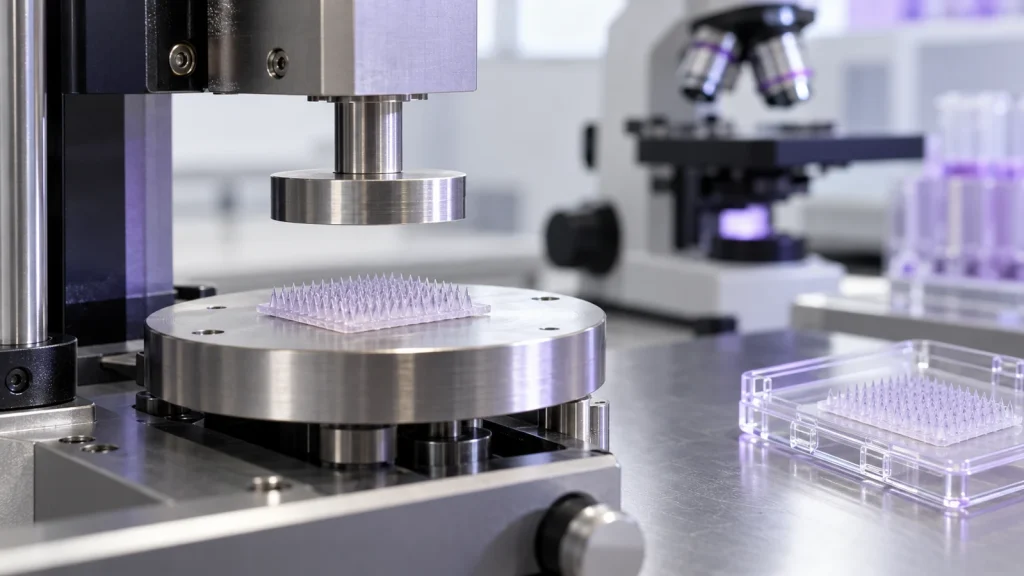
A dissolving microneedle patch needs a mechanical test method with defined geometry, conditioning, loading and failure criteria. Compare samples under the same method, retain images of the tested arrays and evaluate insertion and dissolution as separate development questions.
Translate the design drawing into measurable attributes
An OEM enquiry that specifies only patch diameter and a photograph leaves much of the technical brief open. Record the intended array layout, needle height, base dimensions, tip description and backing geometry. Ask which dimensions will be measured on the finished array and how the measurement method will be documented.
Include a drawing revision and sample identifier on every test record. If an evaluation uses an unloaded development array, identify it as such. The mechanical results for that sample belong to that material and configuration. A formulation-containing prototype needs its own evaluation plan.
Define the physical condition of the sample
The review brief should say how samples are packaged, conditioned and handled before testing. Record the time out of the protective pouch and the applicable environmental conditions. Keep the record short enough for routine use, with a field for deviations. This lets the development team distinguish a design change from a handling difference.
Why a single fracture-force number is difficult to compare
Ando and colleagues studied PVA-based dissolving microneedles in a 2024 original research paper. For one experimental setup, increasing compression speed from 0.5 to 100 mm/min changed the measured fracture force from 0.145 ± 0.006 to 0.203 ± 0.015 N per needle. These are study-specific results. They illustrate method sensitivity and cannot serve as release limits for a different patch. Ando et al., Pharmaceutics, 2024.
The study also found effects from the number of needles compressed, array geometry, residual water and formulation loading. Its practical implication for a development brief is to document these variables before comparing force results. A figure expressed “per needle” still needs the loading arrangement and calculation basis.
Earlier original work by Lee, Park and Prausnitz evaluated mechanical properties and insertion using separate approaches. That distinction remains useful when defining what a prototype test is expected to show. Lee et al., Biomaterials, 2008.
Build a test brief that another laboratory can understand
| Method field | What to record | Question it resolves |
|---|---|---|
| Sample identity | Batch, formulation, array drawing and packaging revision | Which physical prototype was tested? |
| Conditioning | Agreed environment and pre-test handling | Were samples evaluated in comparable condition? |
| Loading setup | Probe geometry, alignment, speed and contact area | How was force applied? |
| Endpoint | Defined deformation or failure criterion | What event produced the reported value? |
| Reporting | Individual results, calculation basis and images | Can reviewers inspect variation and failure appearance? |
Keep compression, insertion and dissolution endpoints separate
Write a specific question for each test. A compression evaluation can characterize deformation under its defined fixture. An insertion study needs a justified model and a way to assess the specified endpoint. A dissolution evaluation needs its own medium or model, conditions and endpoint. The project team should approve the relevance of each model to the intended product.
A useful development report gives each endpoint a separate results section. If a sample performs differently across tests, keep that finding visible. Combining everything into a single “passed” statement makes it harder to decide which design or formulation variable to investigate.
Plan the sample comparison before testing starts
- Choose the design question, such as the effect of a backing or formulation change.
- Identify the variable being changed and the conditions held constant.
- Agree the sample count and allocation with the responsible testing team.
- Define how individual results, variation and unusual observations will be reported.
- Set a review decision that can lead to revision, further evaluation or an agreed specification.
For example, a project could compare two prototype formulations under one approved compression method. The comparison table should identify both formulations and every test condition. It should leave the acceptance column open until the responsible team has justified the criterion. This avoids turning a convenient literature value into a product requirement.
Frequently asked questions
Is there one minimum fracture force for every dissolving patch?
A universal value cannot be taken from the studies cited here. The material, geometry, conditioning, test setup and intended product all affect how a result should be interpreted.
Does a compression test establish skin delivery performance?
A compression test answers the question defined by its fixture and endpoint. Insertion, dissolution and delivery claims require relevant evidence for those separate endpoints and the intended product.
Can an empty array represent the final formulation?
Use it as an identified development sample. Evaluate the formulation-containing prototype under an approved plan before relying on the empty array’s result for the final configuration.
What should a microneedle OEM enquiry include?
Provide the intended use, destination market, array drawing, formulation concept, backing and packaging needs. Add the test questions and reporting requirements you need the development team to assess.
Sources and scope
- Ando et al. Mechanical Characterization of Dissolving Microneedles. Pharmaceutics 16(2), 200 (2024). DOI: 10.3390/pharmaceutics16020200.
- Lee, Park and Prausnitz. Dissolving Microneedles for Transdermal Drug Delivery. Biomaterials 29, 2113-2124 (2008). DOI: 10.1016/j.biomaterials.2007.12.048.
Published experimental findings are attributed to their authors. They are not PeptideVaultPro test results, regulatory clearance or proof of efficacy. This article addresses development documentation and provides no consumer application instructions.
Discuss a microneedle patch development brief or review our quality documentation approach.
