
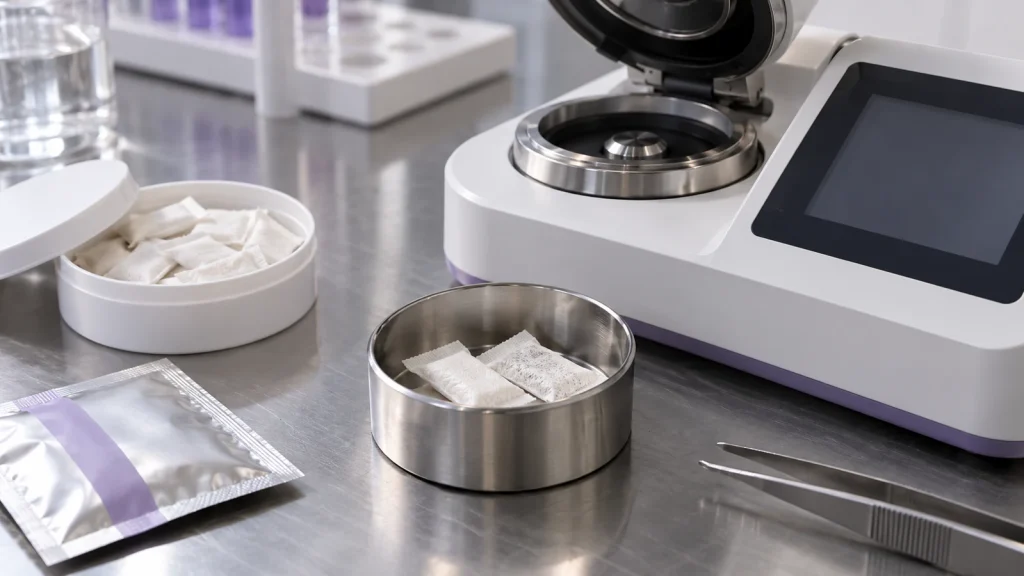
An oral pouch quality brief should connect ingredient eligibility, unit composition, water activity and the final package. Measure each attribute against a defined specification. A water-activity number alone cannot establish microbiological safety, shelf life or permission to market the formulation.
Set the product and ingredient scope first
Identify the intended use, formulation, claims and destination market before selecting a quality standard for an oral pouch. The package format cannot decide which ingredients are permitted. A research peptide listing does not establish that the ingredient may be incorporated into an ingestible or oral-contact consumer product.
For products legally marketed as dietary supplements in the United States, FDA explains that applicable manufacturing requirements address identity, purity, quality, strength and composition. Its small-entity guide discusses specifications for components, in-process production, product, packaging and labels. These are requirements within a defined US regulatory category, not a universal approval of pouch products. FDA dietary supplement questions and answers; FDA small-entity CGMP guide.
Write down the decisions that need external review
Keep an unresolved-items list for ingredient eligibility, product classification and proposed claims. Assign responsibility for each review. Development samples can be assessed while those questions are being resolved, but the commercial brief should show which decisions remain open and which have been documented.
Water activity and water content describe different attributes
Water activity, written aw, relates the vapor pressure over a sample to that over pure water at the same temperature. FDA expresses the relationship to equilibrium relative humidity as aw = ERH/100. Thus, an illustrative ERH of 60% corresponds to a water activity of 0.60 at the measurement conditions. This is a definition and calculation, not an oral-pouch acceptance limit. FDA: Water Activity in Foods.
USP General Chapter <922> distinguishes total water from the fraction available for relevant reactions and describes the qualification, calibration and use of water-activity meters. Its publicly accessible introduction supports that distinction; the full chapter requires appropriate access. USP <922> preview.
Why 0.85 is not a general pouch target
FDA’s technical guide discusses 0.85 in the context of determining coverage under specific low-acid canned-food and acidified-food regulations. It does not supply a universal oral-pouch release limit. Set the product’s control strategy through a competent assessment of the formulation, process, microbiological risks and applicable requirements.
For the development record, specify the sample condition, measurement temperature, instrument checks and reporting method. If a test uses pooled material or removes material from the pouch, document that preparation. Consistency in preparation makes a comparison between prototype batches easier to interpret.
Evaluate what is inside each pouch
| Attribute | Development question | Evidence to define |
|---|---|---|
| Unit fill mass | How consistent is the amount filled? | Sampling plan, individual measurements and acceptance approach. |
| Ingredient distribution | Does the selected ingredient meet its unit-level specification? | Suitable assay, extraction basis and representative sampling. |
| Water activity | What is measured under the agreed conditions? | Preparation method, temperature, instrument controls and result. |
| Pouch construction | Does the prototype meet its handling and containment requirements? | Defined physical checks and observations. |
| Final package | Do the agreed attributes remain acceptable during evaluation? | A justified stability plan using the intended commercial package. |
A proposed sampling plan should say where units come from within the development batch and which tests consume separate units. Record individual results when the question concerns variability. Before approving a plan, ask the laboratory how it will extract and measure the selected ingredient from the complete pouch matrix.
Fill mass and ingredient assay should have separate fields in the report. This allows reviewers to examine whether an observed difference follows the amount filled, the formulation distribution or the measurement procedure. The development team can then choose the investigation needed for that finding.
Evaluate the final package as part of the product
Record the can or sachet specification, closure, pouch count and any defined storage conditions in the stability brief. Use the proposed commercial configuration for the questions that depend on that package. If repeated opening is relevant to the intended presentation, ask the responsible team whether an in-use evaluation belongs in the plan.
Request a final report that connects changes in measured attributes to the tested package and study conditions. Keep the proposed shelf-life decision separate from early observations. A short prototype study can guide the next development step without establishing the finished product’s expiry period.
Frequently asked questions
Does low water activity establish that a pouch is sterile?
A water-activity measurement does not establish sterility. Microbiological specifications and the evidence supporting them need a separate, product-specific assessment.
Is 0.85 the required water-activity limit for oral pouches?
The FDA reference discusses that value in a particular food-regulatory context. It is not a universal oral-pouch limit; select the applicable criteria through the product’s technical and regulatory review.
Can unit fill weight replace an ingredient assay?
Fill weight measures the amount of material in a unit. Define an appropriate assay and sampling plan when the question is the amount or distribution of a particular ingredient.
Can every catalog peptide be used in a consumer oral pouch?
Catalog presence does not establish ingredient eligibility or permission for that route and market. Confirm the ingredient, product category and proposed claims before a commercial formulation is approved.
Sources and scope
- FDA Water Activity in Foods: definition and the stated context of 0.85.
- USP <922> Water Activity, public preview: water activity and measurement principles.
- FDA small-entity dietary supplement CGMP guide: specifications within its stated scope.
- FDA dietary supplement questions and answers: product-category information.
This article proposes development review fields. It does not claim that PeptideVaultPro holds a certification, has validated a pouch formulation, or can supply every ingredient for every market.
Prepare an oral pouch project brief, or compare requirements for oral dissolving films.
