
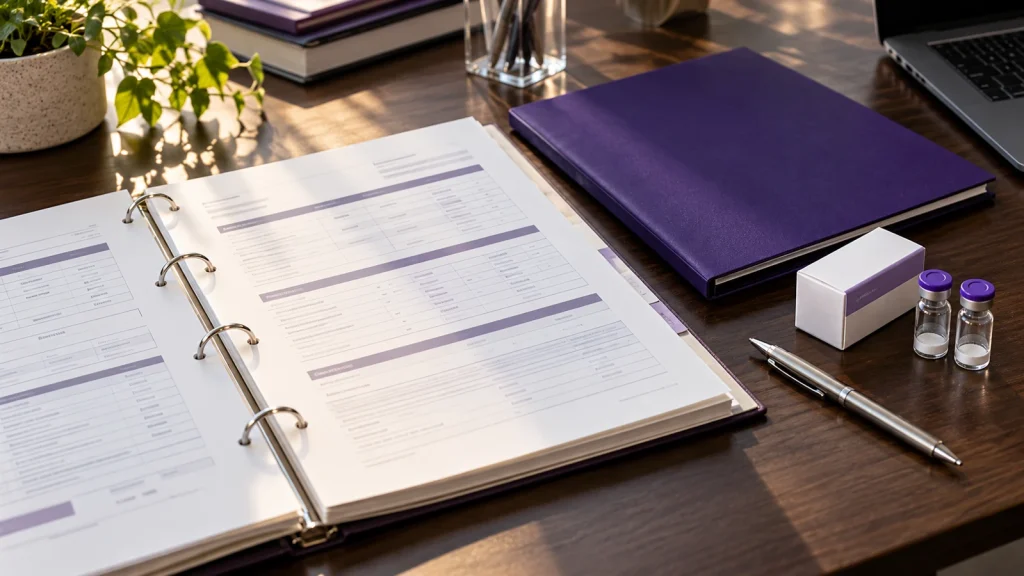
A peptide CDMO quality agreement should name who approves specifications, performs and reviews testing, investigates deviations, authorizes changes and decides batch disposition. Record those responsibilities before the first acceptance batch. A commercial quotation seldom contains enough detail to govern a disputed result or a manufacturing change.
Define the project and the quality decisions it requires
Describe the exact work being outsourced. A custom peptide synthesis project, a cosmetic raw-material order and a finished oral-film development project involve different decisions. List the material or product, the participating sites, the development stage and the records that the buyer expects to receive.
The FDA’s November 2016 quality-agreement guidance concerns contract drug manufacturing under CGMP. It recommends clearly documenting manufacturing roles and responsibilities and keeping the quality agreement separate from, or severable from, the commercial agreement. The guidance’s drug-manufacturing scope matters: it does not certify a supplier or automatically set the legal requirements for a cosmetic or research-material project.
Specify what “release” means for this contract
One party may use “released” to mean that its laboratory has approved a test report. Another may use it for the manufacturer’s batch disposition, and the buyer may mean acceptance for its own operation. Name each decision and the authorized role. The documents should show when the product can leave the manufacturing site and when the buyer considers the order accepted.
Assign an owner to each record and decision
An activity matrix should distinguish who performs a task, who approves it and who receives the resulting record. Keep contacts current and identify the alternate responsible role. Avoid an approval arrangement that depends on one person’s email address without a defined replacement.
| Activity | Questions to resolve | Expected record |
|---|---|---|
| Material identity and specification | Who approves the identity, grade and acceptance criteria? | Approved specification and revision history |
| Analytical testing | Which laboratory, method and reference standard apply? | COA, method references and agreed supporting data |
| Deviation or out-of-specification result | Who leads the investigation and approves its conclusion? | Investigation and disposition records |
| Change control | Which changes require prior notification or approval? | Impact assessment, approval and implementation record |
| Packaging and distribution | Who owns component approval and excursion assessment? | Package specification and shipment or excursion records |
| Complaints and returns | Who receives, investigates and communicates the outcome? | Traceable complaint and agreed follow-up |
For a peptide order, resolve purity, content and quantity basis in the specification itself. For a cosmetic ingredient, connect it with the identity and composition record. The agreement should point to controlled documents, so an updated spreadsheet does not silently replace an approved requirement.
Make the change process usable
List the changes that need technical review for this product. Depending on the project, these can include raw-material identity or source, manufacturing site, analytical method, reference standard, product-contact packaging and a declared formulation component. Agree how the parties classify the change and determine whether further work is needed.
ICH Q10, dated 4 June 2008, describes four pharmaceutical quality-system elements: process-performance and product-quality monitoring, corrective and preventive action, change management and management review. Its scope is pharmaceutical development and manufacture. The elements offer a practical set of questions for an outsourcing discussion, with the contractual controls adapted to the actual product and market.
A packaging-change example
Suppose a supplier proposes a different stopper for a lyophilized product. The agreement should identify the notification route, the technical information the buyer receives and the approval needed before the new component is used. The assessment may need to address the product-contact materials, packaging compatibility and the evidence supporting the storage claim.
The decision should identify the first affected batch and the applicable specification revision. It should also address any stock made under the previous configuration. A clear batch boundary makes receiving checks possible.
Agree how an analytical disagreement is handled
Include a route for investigating conflicting test results. The first review should cover sample identity, sampling and handling history, method revision and result basis. Define access to the relevant data and the circumstances in which additional testing can be justified.
A third-party laboratory can help when the parties agree on its role, methods and acceptance rules in advance. It should not be used as a way to keep testing until a shipment passes. Record the original result and the investigation that explains any subsequent decision.
What the buyer should send before the agreement is drafted
- The product identity, intended use, destination market and development stage.
- The proposed specification and known analytical-method requirements.
- The deliverables expected from development, testing and manufacturing.
- The packaging and distribution brief.
- The contacts authorized to approve specifications and changes.
- Any customer or downstream quality requirements the supplier must assess.
Frequently asked questions
Does an OEM or CDMO quotation replace a quality agreement?
A quotation defines a commercial offer. Quality responsibilities, investigation access and change approvals need explicit agreement where those activities are part of the project.
Who should approve a peptide specification?
The contract should identify the supplier’s and buyer’s authorized technical or quality roles and the decisions each makes. Approval needs to occur before the specification is used to accept a batch.
Can a supplier change a packaging component without notice?
The agreement should define which packaging changes require notification or approval and the information needed for impact assessment. The decision must remain traceable to the affected batches.
Does citing ICH Q10 show that a supplier is certified?
No. ICH Q10 is a pharmaceutical quality-system guideline. A supplier’s actual system, site scope and relevant evidence require a separate qualification review.
Sources and further reading
- FDA, Contract Manufacturing Arrangements for Drugs: Quality Agreements, November 2016.
- ICH, Q10 Pharmaceutical Quality System, 4 June 2008.
Provide your current specification and outsourcing scope for an OEM, CRO or CDMO project enquiry. Related reading: selecting OEM versus CDMO support and technical documentation.
