
Technical resources
Measuring peptide recovery across a sample filter
A filtered sample may contain less liquid, less analyte or a matrix that produces a different signal. Measure concentration and recovered volume in a paired laboratory study before attributing a changed peptide result to membrane binding.
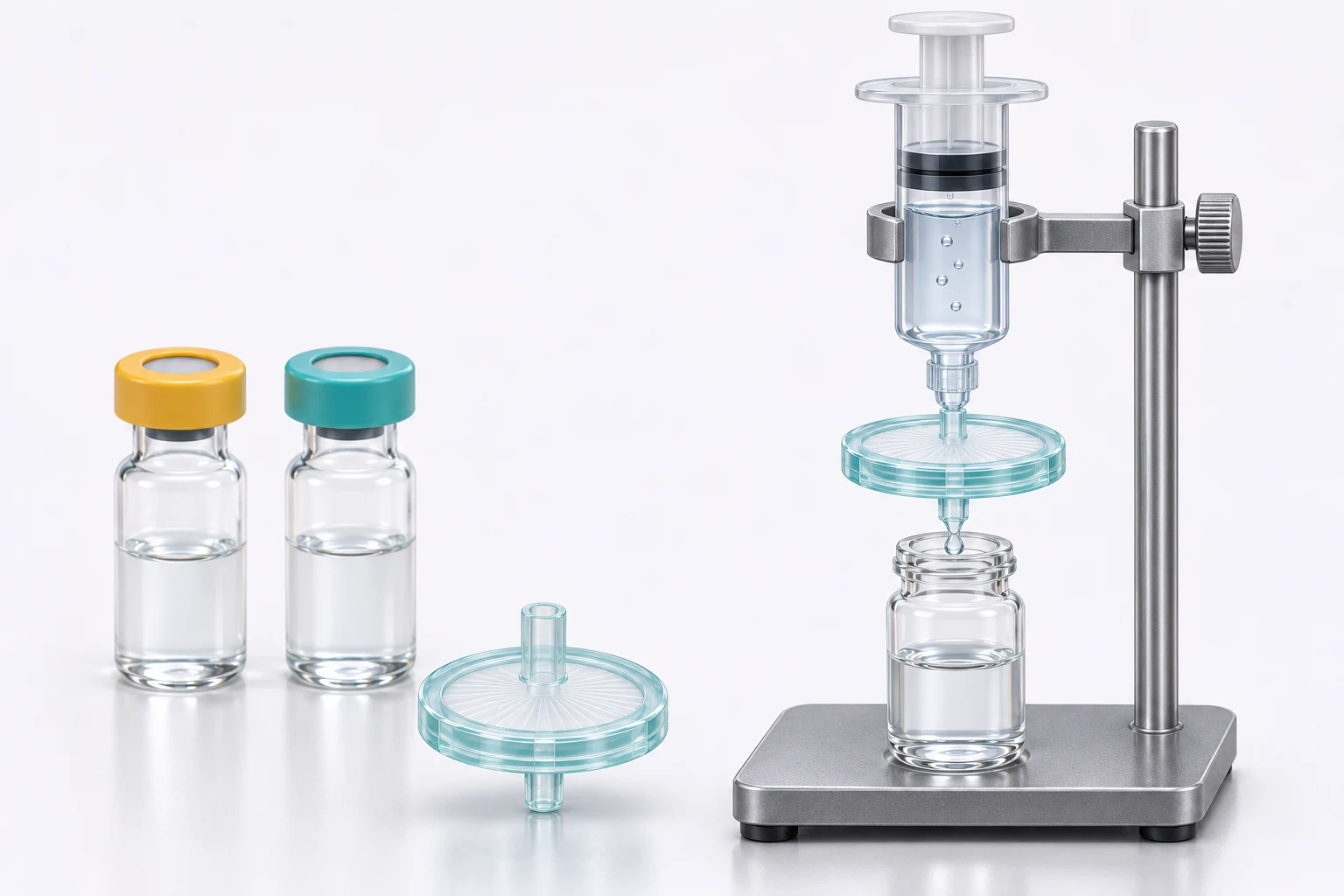
A filter can solve a particulate problem while introducing a new analytical question: how much target peptide reaches the collection vessel? Compare recovered amount as well as concentration. A smaller volume with unchanged concentration represents a different outcome from the same volume with a lower concentration.
This article concerns preparation of laboratory samples for analysis. It provides no preparation instructions for human use and does not establish sterility. The filter assessment should follow the instrument’s sample requirements and the laboratory’s handling procedure.
Describe the complete filter assembly
Record membrane chemistry, nominal pore size, diameter, housing, product identifier and lot. Include the loading device and receiving container. If liquid contacts a syringe and tube before and after filtration, the membrane is only one part of the route.
A Sartorius experimental application note compared membrane types and sample conditions using model proteins. It found condition-dependent recovery. Those protein results justify examining the assembly and conditions, but they do not establish the best membrane or expected recovery for an arbitrary synthetic peptide.
Prepare paired comparison branches
From a suitable common preparation, allocate a filtered branch and a comparison branch that bypasses the filter while matching other handling. Confirm that the comparison sample can be measured safely by the chosen analytical procedure; an unsuitable particulate sample should not be injected merely to complete a pair.
Use fresh filter units for independent replicates. Keep the loaded amount, collection arrangement and elapsed time consistent. Run a filter blank containing the preparation liquid without peptide through a separate assembly to examine introduced background.
Calculate recovered amount
Record the volume loaded and the volume collected using a suitable measurement. When the assay provides a valid concentration, calculate recovered amount as concentration multiplied by collected volume. Apply all dilution factors and keep units visible.
For illustration only, a sample at 10 micrograms per milliliter containing 1.0 milliliter holds 10 micrograms. Collecting 0.8 milliliters at the same concentration yields 8 micrograms in the receiver. That arithmetic does not identify whether the remainder is in retained liquid, adsorbed material or another unmeasured location.
If the investigation needs fractions, label the initial and later filtrate portions separately. Treat any permitted rinse as an additional fraction with its own composition and volume. Do not merge fractions before the comparison if doing so would erase the information needed to locate the loss.
Separate recovery from response changes
Use a suitable analytical comparison for the resulting matrices. A cleaner filtrate may produce a stronger LC-MS signal even when less peptide reaches the receiver. The laboratory should examine whether the response difference reflects analyte amount, matrix interference or both.
Check whether a standard introduced after filtration behaves differently in filtered and unfiltered comparison matrices. Such a check examines the measurement environment; it does not measure losses that occurred before the spike. Keep the raw response and calculated amount together so the interpretation can be reviewed.
Choose a filter for the actual sample
Compare candidates at the relevant low and high sample amounts, using independent preparations and realistic collection volumes. Set an acceptable recovery and precision requirement for the intended assay before choosing a winner. Record any background that compromises the target measurement.
The existing recovery guide provides the broader sample context. A completed filter study should add an exact assembly and preparation scope. Reassess that conclusion when the peptide, solvent or filter assembly changes materially.
Questions and answers
Can unchanged concentration hide a filtration loss?
Yes. Less collected liquid at the same concentration contains less recovered analyte. Measure both volume and concentration when the question concerns total amount reaching the receiving vessel.
Does a higher filtered-sample peak mean recovery exceeded 100 percent?
Not necessarily. The matrix or measurement response may have changed. Confirm the calibration and comparison conditions before interpreting the larger peak as a greater recovered amount.
Why use a separate filter blank?
It helps identify background introduced by the filter assembly or handling route. Prepare it with the relevant liquid and conditions, and evaluate it using the same analytical channels as the sample.
Can filter data for a protein be applied directly to a short peptide?
No. Use those data to identify variables worth testing. The peptide’s own recovery must be evaluated under the intended preparation conditions before making a material-specific conclusion.
Should retained and rinsed fractions be pooled immediately?
Keep them separate when locating the loss is the objective. Record their individual compositions and volumes. Pooling too early prevents a later calculation of where the measured amount was recovered.
