
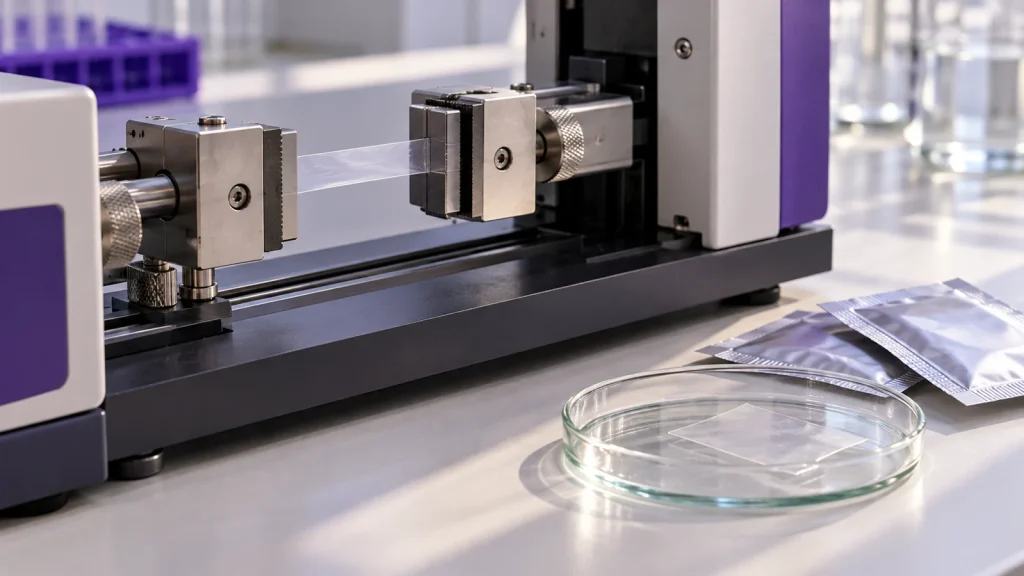
An oral dissolving film specification should define the amount and uniformity of its declared ingredient, the film’s physical performance, its moisture-related behaviour and the protection offered by its pouch. A quick dissolving demonstration supplies only one observation. Commercial acceptance needs agreed tests on representative packaged units.
Define the declared amount before asking for uniformity
Write the ingredient identity, quantity per film and analytical basis into the development brief. Clarify whether a stated number describes the target ingredient or a blend containing it. For a peptide project, the difference between chromatographic purity and peptide content also affects what the declared amount means.
A result from a combined sample gives information about that combined sample. It does not show how much the individual films vary. If uniformity matters to the product specification, agree a unit-level evaluation and a representative sampling plan with the testing laboratory.
Use pharmacopeial concepts within their scope
USP’s explanation of General Chapter <905> distinguishes content-uniformity and weight-variation procedures. It describes an initial evaluation of 10 dosage units and a further 20 when the chapter’s second stage is required. These are pharmaceutical dosage-unit concepts. Whether a compendial procedure applies to a particular oral-film project depends on the product’s classification, applicable requirements and method suitability.
Do not treat a film’s dimensions or mass as a substitute for ingredient measurement without a justified basis. A supplier and buyer should state exactly which result they will use for release and which observations support process evaluation.
Give a dissolving-time claim an endpoint and a method
“Dissolves quickly” can describe several observations: initial softening, loss of structure, disappearance of visible pieces or release of a measured ingredient. A development report should identify the observation it calls the endpoint. The sample preparation, test environment and method reference must allow another laboratory to interpret the result.
Do not borrow a tablet benchmark for every film
The FDA’s December 2008 guidance on orally disintegrating tablets recommends an in-vitro disintegration time of approximately 30 seconds or less for the ODT designation and discusses the method dependence of the result. The document concerns tablets. It does not establish a universal 30-second acceptance limit for every oral dissolving film.
For a film, ask the developer to justify the proposed endpoint against the product’s intended performance. An in-vitro disintegration observation does not establish clinical absorption, bioavailability or effectiveness. Any such claim needs evidence that addresses the actual claim.
Evaluate handling and the final pouch together
A film must survive the agreed manufacturing, packaging and distribution process and remain removable from its pouch. Include observations such as tearing, adhesion to the liner, curling and blocking in the development review. Record the sample’s conditioning and package history with those observations.
USP <922> distinguishes available water from total water content. That distinction can help frame a moisture-related investigation, but it does not supply a ready-made acceptance limit for an oral-film formulation. Ask the technical team which measurements are relevant to the proposed film and why.
A commercial test brief
| Attribute | Document before sampling | Decision supported |
|---|---|---|
| Ingredient amount | Identity, quantity basis and assay procedure | Does the film meet its agreed composition claim? |
| Individual-unit uniformity | Sampling plan, analytical approach and acceptance rule | Is the declared ingredient sufficiently consistent between evaluated units? |
| Disintegration or release | Defined endpoint and method conditions | Does the sample meet the agreed in-vitro performance? |
| Physical handling | Sample dimensions, conditioning and chosen observations | Can the film be processed and removed as intended? |
| Packaged stability | Final pouch construction and product-specific study plan | What storage period and conditions does the evidence support? |
Connect sample approval to the manufacturing specification
Keep the approved sample, formulation reference, analytical methods and package construction linked by document revision. A later change to film composition, coating or casting arrangements, cutting pattern or pouch needs a documented assessment of its effect on the agreed attributes. The required assessment depends on the change.
- Agree the intended use and destination-market classification.
- Define the ingredient and physical-performance claims that need evidence.
- Confirm methods and acceptance criteria before the acceptance sample is tested.
- Evaluate the sample in its proposed final pouch.
- State which results must accompany a commercial batch and who approves changes.
For development procurement, identify the deliverable at each stage: a feasibility observation, an accepted prototype or an approved commercial specification. That prevents an early sample demonstration from being treated as a completed product qualification.
Frequently asked questions
Must every oral dissolving film disintegrate within 30 seconds?
No universal limit follows from the FDA’s ODT guidance, which addresses tablets. A film needs a justified specification and a defined method appropriate to its product and market.
Does a uniform film weight establish ingredient uniformity?
Weight alone does not establish the amount of a declared ingredient in each film. The proposed approach needs technical justification and, where required, individual-unit analytical results.
Does a fast in-vitro result prove absorption?
No. Disintegration and ingredient release are different questions from absorption or clinical effect. Claims about the latter require evidence specific to the product and claim.
Which package should be used for the stability evaluation?
Use the intended final pouch or a configuration justified by the technical study plan. Record its material construction and sealing specification so the evidence remains traceable to the commercial pack.
Sources and further reading
- USP, explanation of General Chapter <905>, Uniformity of Dosage Units.
- FDA, Orally Disintegrating Tablets, December 2008 guidance.
- USP, General Chapter <922>, Water Activity.
Send the intended ingredient, film format, market and proposed claims for an oral-film OEM assessment. Related reading: oral-film development questions and quality responsibilities.
