
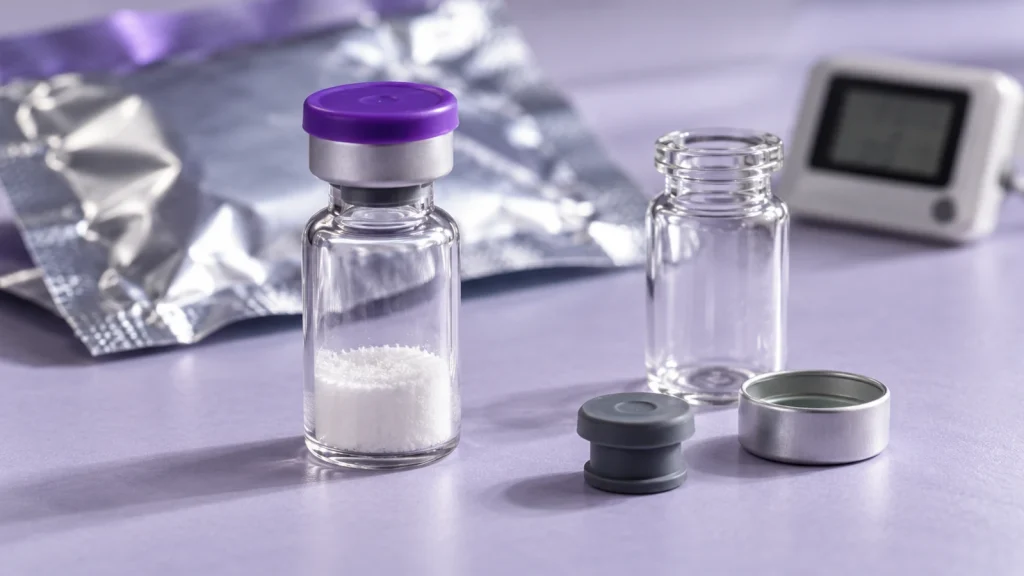
A useful moisture specification connects a defined water measurement with the peptide’s stability evidence and its final packaging system. Residual water content, water activity and container-closure integrity describe different properties. None of these results alone establishes shelf life, sterility or suitability for an intended use.
Separate total water from water activity
Total water content reports the amount of water measured in the sample by a defined procedure. Water activity addresses the availability of water within that material. A buyer should request the quantity needed to answer the specific quality question and keep the method attached to the result.
USP General Chapter <922>, Water Activity, explains that some water can be tightly bound while other water is more available to participate in reactions or support microbial growth. It points to <921> for water-content determinations and treats water activity as a separate measurement. The distinction matters when two powders show similar total-water results but differ in composition or physical behaviour.
Ask what the moisture limit protects
A supplier may propose a moisture acceptance limit from development work, an established product specification or a compendial requirement relevant to the product. Request that basis. A single percentage copied from another peptide does not establish the right limit for the material being purchased.
- Which measurement is specified, and in what units?
- What material or product data supports the proposed limit?
- Does the result describe the bulk powder or the final packaged vial?
- How is exposure between sampling and measurement controlled and documented?
- Which other quality attributes are monitored during the stability evaluation?
Treat the vial, stopper and seal as one packaging system
The packaging record should identify the glass container, stopper, seal and any secondary barrier used for the offered product. Record the component references and the final package configuration evaluated. A photograph of a neat crimp or an intact flip-off cap supplies little information about a package’s protective performance over time.
USP <1207>, Package Integrity Evaluation—Sterile Products, addresses integrity assurance for nonporous packages intended for sterile pharmaceutical products. Its public introduction connects leakage limits with maintaining sterility and relevant physicochemical specifications, and describes a lifecycle approach to package evaluation. This is a sterile-pharmaceutical reference. A cosmetic or research powder project needs a package assessment appropriate to its own intended use; citing the chapter does not make that powder sterile.
Keep appearance, barrier performance and sterility claims separate
| Evidence | Question it can address | What to check next |
|---|---|---|
| Visual inspection | Are specified visible defects present? | Defect definitions, inspection scope and any additional integrity evidence |
| Water-content result | How much water did the procedure measure? | Method, sample history and stability relevance |
| Water-activity result | How available is water within the tested material? | Method suitability and product-specific interpretation |
| Package integrity evaluation | Does the selected package meet its defined integrity criterion? | Method capability, packaging configuration and lifecycle conditions |
| Stability study | Does the packaged product retain its agreed attributes over the evaluated period? | Study design, analytical methods and the exact shelf-life claim supported |
Write a test brief around the final pack
Start with the product identity and intended supply format. Specify whether the review concerns a bulk container, an individual vial or a vial inside a secondary overpouch. Each configuration exposes the material to a different packaging system, so the tested configuration should be traceable to the one ordered.
- List the material specification and the packaging component references.
- Identify the quality attributes whose change would make the product unacceptable.
- Ask the technical team to justify the proposed measurements and acceptance criteria.
- Include the intended storage and distribution conditions in the evaluation scope.
- Agree how component changes, excursions and observed failures will be investigated.
- Define which records the buyer receives before commercial batch acceptance.
Follow up a distribution excursion with evidence
If a shipment arrives outside its agreed conditions, preserve the packaging, logger data and lot details. Ask the responsible quality team to assess the actual exposure against the product’s available stability evidence. Neither a normal-looking powder nor a single release COA resolves an excursion that occurred after release.
Record the decision and its supporting documents. If the evidence is insufficient, request further technical assessment before accepting the affected shipment. Set the communication responsibilities in the quality agreement so the issue has a clear owner.
Frequently asked questions
Is a lower residual-water result always better?
The suitable range depends on the material and its supporting development and stability evidence. A purchasing specification should use a justified acceptance criterion, not a universal “lowest possible” target.
Can water activity replace a water-content result?
They measure different properties. The technical specification should state which measurement is required and how its result supports the quality assessment.
Does a sealed vial prove that the powder is sterile?
No. Closure appearance alone does not establish sterility. A sterile-product claim requires its own applicable manufacturing, testing and package-integrity evidence.
What should accompany a packaging quotation?
Request the package configuration, component references, intended storage and distribution conditions, and the proposed supporting evaluation. Ask which records apply to the offered product and which work remains part of development.
Sources and further reading
- USP, General Chapter <922>, Water Activity, public introduction.
- USP, General Chapter <1207>, Package Integrity Evaluation—Sterile Products, public introduction.
Discuss a lyophilized powder packaging project with the intended product and final-pack brief. Related reading: choosing a vial and storage requirements.
